
The Trump Effect on Canada: Tariffs or Throttle
In 2025, Canada's exports to countries other than the United States rose 17.2%. It was the strongest evidence yet that the country could find customers beyond its southern neighbour.
Then look inside the number. Exports of unwrought gold, silver and platinum rose 41.7%, and gold shipped to the United Kingdom alone grew by about $17 billion. Strip out precious metals, and Canada's total exports did not hold steady. They fell 3%.
So which is it? Is Canada adapting to a hostile trade partner, or riding a gold price while the rest of the export economy shrinks?
Trump did not create Canada's problems. He raised the price of ignoring them.
Interprovincial trade barriers, slow project approvals, thin trade corridors, weak business investment and dependence on a single customer all predate 2025. American access made them affordable to tolerate.
The tariff has already happened. Whether it also becomes a throttle, an external shock that forces Canada to accelerate changes it had postponed, is a Canadian choice. The evidence so far says the choice has not yet been made.
The cost is real, and part of it is permanent
The Bank of Canada projects GDP will be about 1.5% lower by the end of 2026 than it forecast before the tariffs. Roughly half of that shortfall is lost potential output, which interest rates cannot restore.
The average US tariff on Canadian goods looked modest for most of this year, at about 5% in the Bank's July estimate. That number is now out of date. Talks collapsed in August, the United States put 50% tariffs on about $28 billion of Canadian goods from August 22, and Canada matched them with its own on September 8. A threatened 50% tariff on Canadian vehicles and parts is set for January 1, 2027.
The larger tax is uncertainty. With CUSMA now on annual review, no Canadian firm can price five years of access to its biggest market. That is what holds back the investment decisions a throttle depends on.
The pivot is real. Half of it is gold.
Exports to the United States fell about $34 billion in 2025. Exports elsewhere rose about $32 billion, which looks like near-perfect substitution. About $17 billion of that rise was gold shipped to the United Kingdom, much of which may not stop there.
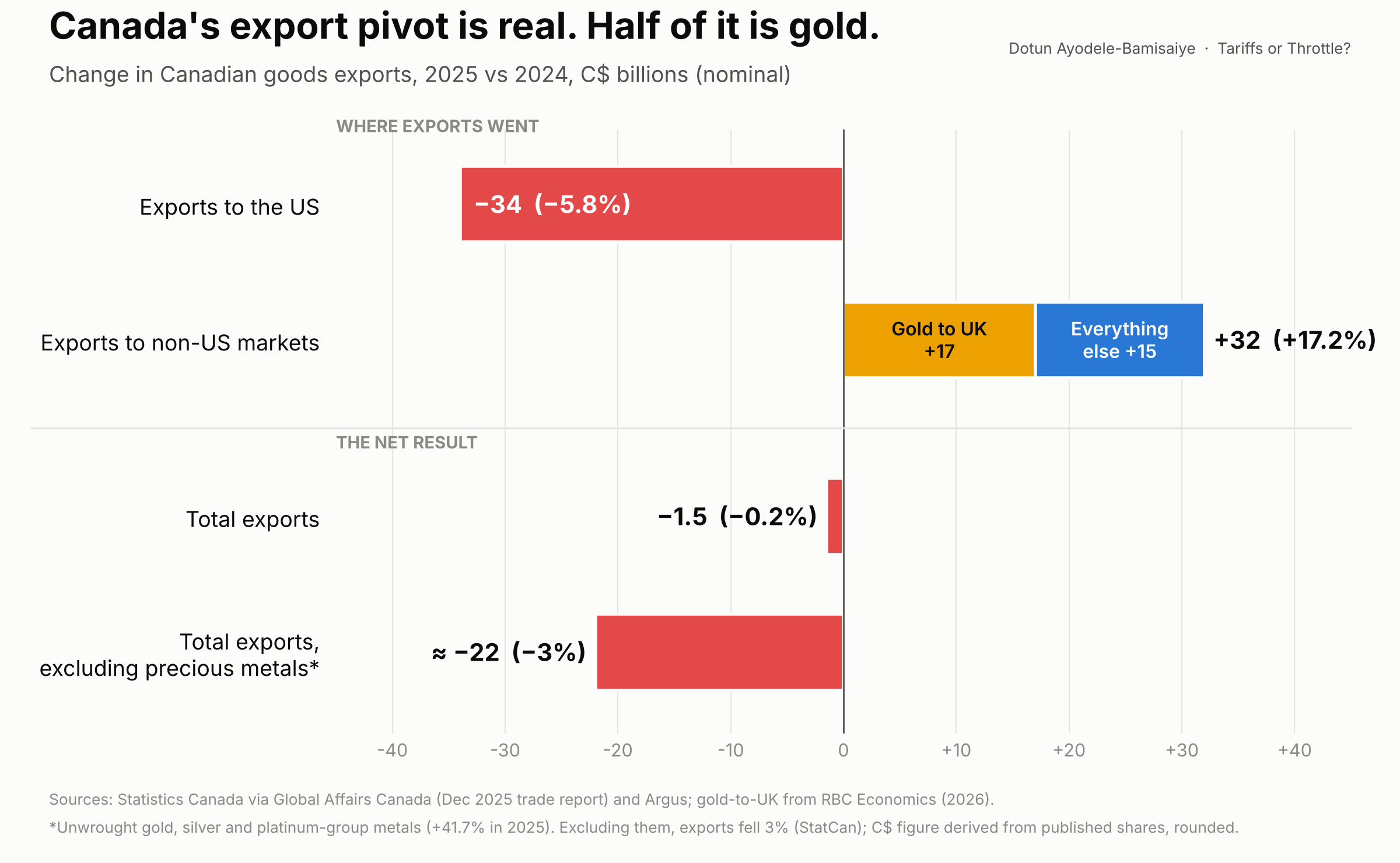
Commodities moved; manufacturing did not. Roughly 75% of Canada's manufactured exports still go to the United States, a share that has barely shifted since tariffs began. Energy, minerals and metals found new buyers. Assembled goods did not.
It is a big-firm story. Firms exporting to several countries are 2% of exporters but earn nearly two-thirds of export revenue. Meanwhile 542 fewer firms exported to the United States in 2025, mostly small and mid-sized ones, and only 292 more found a buyer elsewhere.
The engine is turning over. Business investment rose 2.3% in the second quarter of 2026, ending five straight quarterly declines, and exports posted their largest gain in three years. July output was flat, so one quarter is a signal, not a trend.
Ottawa has pulled the levers. The money has not moved yet.
The first Canada Investment Summit, held in Toronto in mid-September and co-hosted by CPP Investments and PSP Investments, was the government's answer to the investment question. Its stated goal is $1 trillion in investment over five years. It produced roughly $500 billion in announced commitments.
Commitment | Amount | What it actually is |
|---|---|---|
TD Bank | $150B over 5 years | Financing capacity |
Scotiabank | $100B+ over 5 years | Financing, underwriting, investment |
BMO | $70B over 10 years | Mobilisation capacity |
PSP Investments | ~$100B target | Higher allocation to Canada |
Bell Canada with Saskatchewan | ~$50B | AI data centre build |
CPP Investments with Brookfield | $50B over 5 years | New infrastructure fund |
Ontario Teachers' | $10B by 2027 | New Canadian investment |
CIBC | $2B over 5 years | Financing for defence and dual-use SMEs |
Read the third column carefully. Most of the headline total is lending and allocation capacity, money available if projects appear, not capital committed to specific assets. That is not a criticism of the summit. It is a statement of where the bottleneck now sits: in the pipeline of investable Canadian projects and firms.
The policy side was more concrete:
The Productivity Mega Deduction allows a full first-year write-off for about 65% of capital assets, up from about 15%, including software, pipelines and mining property. It is permanent and costs an estimated $36 billion over five years. TD Economics calls it "meaningful, but not game changing in isolation," with benefits flowing from mid-to-late 2027.
Faster certainty for large investors. The CRA will prioritise advance tax rulings for investments of $1 billion or more.
Pacific Link pipeline (October 1): a 1 million barrel per day west coast pipeline, majority owned by Ottawa and Alberta, with Indigenous communities offered at least 10%. It goes through a single federal review targeted to finish by September 1, 2027.
The Major Projects Office had already received 15 projects and six strategies worth more than $126 billion by April.
The pattern is consistent. Canada is building the infrastructure for exporting what it extracts, and the incentives for investing in what it makes. Whether firms use the second is the open question.
Where the throttle actually is
Five levers decide whether the summit's capacity becomes Canadian productive capacity. Each has a cost of inaction.
1. Make SME exporting the priority. Diversification that only large commodity firms can execute will not move national productivity. Export finance, market-entry support and shared logistics aimed at mid-sized manufacturers is the largest gap in the current package. CIBC's $2 billion for defence and dual-use SMEs is the right instinct at a tenth of the right scale. Cost of waiting: every firm that exits the US market without a replacement is capability that does not come back.
2. Enforce internal free trade. The federal internal trade law has been in force since January. Its value depends on provinces accepting each other's standards in practice. It is the one lever that needs no negotiation with Washington. Cost of waiting: a domestic market that stays fragmented while the external one narrows.
3. Process, do not just reroute. Pacific Link diversifies the buyer of Canadian crude. It does not diversify the economy. Refining, upgrading and mineral processing capacity is the test of whether new corridors carry more value or just more volume. Cost of waiting: energy leverage over the United States is time-bound, and buyers in Asia are building alternatives.
4. Split the manufacturing strategy. Defend the integrated North American chain, autos first, through negotiation, with January 1 as the live deadline. Direct new capacity toward products that can sell into several markets. Cost of waiting: plants retooled for a single customer are the most exposed assets in the country.
5. Pair AI investment with its complements. The Bell build and the second-quarter purchases of data-centre processors are investment, not yet productivity. The gain arrives only when firms pair adoption with skills and data infrastructure. Bolting AI onto existing workflows does not raise output per worker. Cost of waiting: compute capacity Canadian firms do not know how to use.
The scorecard
Five indicators will settle the tariff-or-throttle question by 2028. Each is public and tracked by Statistics Canada.
Non-US exports, excluding precious metals. The diversification number with the gold price removed.
Manufactured goods' share of non-US exports. Whether what Canada makes, not only what it digs up, is finding buyers.
Number of SMEs exporting outside the United States. 292 more did in 2025. That number needs to be in the thousands.
Business investment per worker. Whether summit capacity becomes deployed capital.
Labour productivity growth relative to the United States. The final test of everything above.
The window is open. It will not stay open.
Canada has proven it can find new buyers for what it digs up. It has not yet proven it can find them for what it makes. The tools to change that now exist: a permanent write-off on most capital, faster approvals, half a trillion dollars in announced capacity, and a federal government willing to own infrastructure outright.
Those conditions are temporary. The auto tariff deadline arrives on January 1. The gold price that flattered last year's numbers will not hold forever. Summit pledges that are not deployed within two years will quietly become pledges that were never needed. Political consensus formed under external pressure fades as soon as the pressure becomes routine. And global capital that came to Toronto in September is being courted just as hard in Washington, Brussels and the Gulf.
The tariff was decided in Washington. The throttle will be decided in Ottawa, in provincial capitals, and in the boardrooms of Canadian firms that choose this year whether to build for one customer or many.
Ten years from now, will Canadians remember this as the moment America made our economy smaller, or the moment it forced us to build a bigger one? That answer is still ours to write. The time to write it is now.
References
Al Jazeera. (2026a, August 22). Carney: Canada will enact retaliatory US tariffs starting September 8. https://www.aljazeera.com/news/2026/8/22/carney-canada-will-enact-retaliatory-us-tariffs-starting-september-8
Al Jazeera. (2026b, September 3). Canada ready for a trade deal with US that benefits both, Carney says. https://www.aljazeera.com/economy/2026/9/3/canada-ready-for-a-trade-deal-with-us-that-benefits-both-carney-says
Al Jazeera. (2026c, October 1). Canada to fast-track oil pipeline meant to diversify economy away from US. https://www.aljazeera.com/economy/2026/10/1/canada-to-fast-track-oil-pipeline-meant-to-diversify-economy-away-from-us
Bank of Canada. (2026a, January 28). Monetary policy report: Canadian outlook. https://www.bankofcanada.ca/publications/mpr/mpr-2026-01-28/canadian-outlook/
Bank of Canada. (2026b, July 15). Monetary policy report: Tariff assumptions. https://www.bankofcanada.ca/publications/mpr/mpr-2026-07-15/tariff-assumptions/
Bank of Canada. (2026c, September 2). Policy interest rate announcement [As reported by Advisor.ca]. https://www.advisor.ca/economy/economic-indicators/text-of-the-bank-of-canadas-latest-policy-interest-rate-decision/
BetaKit. (2026, September). Tracking the Canadian capital commitments surrounding Carney's investment summit. https://betakit.com/tracking-the-canadian-capital-commitments-surrounding-carneys-investment-summit/
Blake, Cassels & Graydon LLP. (2026, September). Canada Investment Summit signals new opportunities for business. https://www.blakes.com/insights/canada-investment-summit-signals-new-opportunities-for-business/
Global Affairs Canada, Office of the Chief Economist. (2026, February). Monthly trade report: December 2025. https://international.canada.ca/en/global-affairs/corporate/reports/chief-economist/monthly/2025-12
The Hub. (2026, April 29). Fewer Canadian companies exported to U.S. in 2025 as trade war raged on. https://thehub.ca/2026/04/29/fewer-canadian-companies-sold-exports-to-the-u-s-in-2025-as-trade-war-raged-on/
Narcity. (2026, September). Day one of investment summit sees billion-dollar announcements, changes to tax policy. https://www.narcity.com/investment-summit-sees-major-money-announcements
Office of the Prime Minister. (2026, April 17). Prime Minister Carney announces first-ever Canada Investment Summit. https://www.pm.gc.ca/en/news/news-releases/2026/04/17/prime-minister-carney-announces-first-ever-canada-investment-summit
RBC Economics. (2026). Surging gold prices, inroads to foreign markets cushion Canada's exports. https://www.rbc.com/en/economics/canadian-analysis/featured-analysis/insights/surging-gold-prices-inroads-to-foreign-markets-cushion-canadas-exports/
Statistics Canada. (2026a, April 24). Trade in goods by exporter characteristics, 2025. The Daily. https://www150.statcan.gc.ca/daily-quotidien/260424/dq260424b-eng.htm
Statistics Canada. (2026b, August 28). Gross domestic product, second quarter 2026 [As reported by The Canadian Press]. https://www.advisor.ca/economy/economic-indicators/economy-grew-3-3-annualized-in-q2-as-q1-figures-revised-higher/
TD Economics. (2026, September). Productivity Mega Deduction = mega growth? https://economics.td.com/ca-productivity-mega-deduction
Xinhua. (2026, February 20). Canada's international merchandise trade deficit widens in 2025 [Via Bernama]. https://bernama.com/tv/news.php?id=2525731
